Skip to content
Skip to content
Back to blog
ProductMay 21, 202614 min readNumeo Team

Introducing AI Hub

AI Hub is an AI-powered dispatcher assistant that automates load discovery, ranking, broker outreach, and negotiation while escalating judgment calls back to dispatchers.

Product

Introducing AI Hub

Introducing AI Hub

Introduction

In the trucking industry, dispatchers play a crucial role in sourcing and booking loads that keep fleets moving profitably. However, the process of finding suitable loads is often fragmented, time-consuming, and prone to missed opportunities. Dispatchers typically navigate multiple load boards and brokerage portals, manually filtering and comparing thousands of load options daily. They must also negotiate rates and terms with brokers, a process that requires both speed and judgment.

AI Hub is designed to address these operational challenges by serving as an AI-powered dispatcher assistant. It automates the discovery, ranking, negotiation, and booking of loads by integrating data from numerous load sources into a unified interface. Dispatchers interact with AI Hub using plain English queries, and the system applies dispatcher-defined rules to filter and rank loads. Importantly, AI Hub escalates decisions that require human judgment back to the dispatcher, preserving critical control points.

This post provides an in-depth explanation of AI Hub’s workflows, integration context, user control boundaries, and implementation considerations. It aims to clarify how AI Hub fits into dispatcher operations and the practical implications of its automation capabilities.


What the Product Does

AI Hub functions as an AI dispatcher assistant that streamlines the load sourcing and booking process by automating several key steps. The following detailed workflow illustrates how AI Hub supports dispatchers:

1. Plain English Load Search

Dispatchers initiate load searches by entering queries in natural language, specifying criteria relevant to their operational needs. This approach removes the need to learn complex filters or navigate multiple load boards separately. Typical query parameters include:

  • Origin and destination: Cities, states, or regions (e.g., "Chicago, IL to anywhere")
  • Equipment type: Reefer, flatbed, van, or other specialized equipment
  • Deadhead distance tolerance: Maximum allowable empty miles before pickup (e.g., under 30 miles)
  • Minimum rate per mile (RPM): The lowest acceptable rate to ensure profitability
  • Date or time constraints: Loads available today, tomorrow, or within a specific window
  • Additional preferences: Broker quality, driver compatibility, or lane restrictions

Example queries:

  • "Chicago, IL to anywhere, reefer only, under 30 mi deadhead, min $2.80/mi"
  • "Van loads from Chicago to Dallas today"
  • "Flatbed from Houston, min $2.60/mi"

The natural language interface allows dispatchers to express their needs flexibly and quickly, reducing the friction of traditional search forms.

AI Hub Search Interface

2. Load Discovery and Ranking

Upon receiving a query, AI Hub simultaneously queries multiple integrated load sources, including public load boards and brokerage portals. It aggregates these results and applies dispatcher-defined rules to filter and rank loads. These rules may include:

  • Equipment compatibility
  • Preferred lanes or geographic regions
  • Minimum RPM floors to ensure profitability
  • Deadhead distance limits to minimize empty miles
  • Broker quality scores based on historical reliability and payment timeliness
  • Driver fit, considering driver certifications, preferences, or restrictions

AI Hub strictly enforces these rules and never surfaces loads that violate them. This filtering reduces cognitive load on dispatchers and ensures that only relevant, profitable loads are considered.

The ranking algorithm prioritizes loads that best match the dispatcher’s criteria, balancing factors such as rate, deadhead, broker reliability, and driver fit.

3. Load Shortlisting and Status Tracking

AI Hub presents a shortlist of recommended loads with clear status indicators reflecting each load’s current state in the booking pipeline. Status categories include:

  • Recommended: Loads that meet all criteria and are ready for dispatcher review
  • Matched: Loads that AI Hub has identified as good fits but have not yet been contacted
  • Being negotiated: Loads where AI Hub is actively communicating with brokers
  • Emailed: Loads for which AI Hub has sent proposals or inquiries
  • Needs action: Loads requiring dispatcher input or approval

This status tracking provides dispatchers with a transparent view of ongoing activities and helps prioritize attention where human intervention is needed.

AI Hub Chat Agent Shortlisting Loads
Load Status Bars Showing Negotiation Progress

4. Automated Broker Outreach and Negotiation

For top-ranked loads, AI Hub can initiate broker outreach autonomously. It sends initial rate proposals aligned with dispatcher preferences and negotiates counteroffers within predefined parameters. The negotiation workflow includes:

  • Sending initial rate proposals based on dispatcher-configured minimum acceptable rates
  • Receiving broker counteroffers and evaluating them against negotiation limits
  • Automatically generating counteroffers within dispatcher-set boundaries
  • Escalating negotiation points that require dispatcher judgment, such as final acceptance or walk-away decisions

For example, if a broker counters a $4,000 rate with $3,000, AI Hub can respond with a counteroffer, provided it remains within the dispatcher’s acceptable range.

This automation reduces the time dispatchers spend on routine negotiation exchanges, allowing them to focus on higher-value tasks.

5. Escalation of Judgment Calls

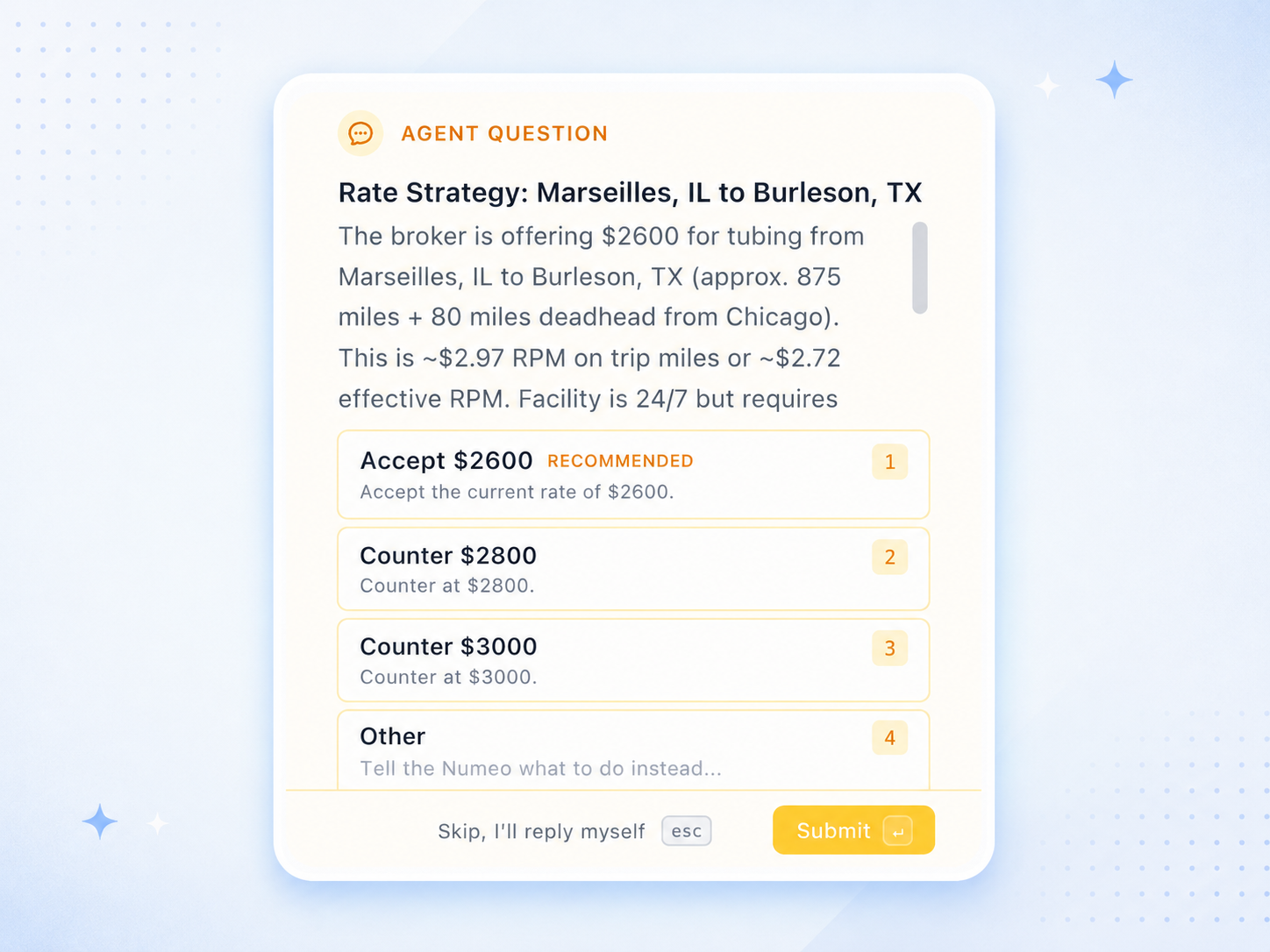
AI Hub is designed to maintain dispatcher control over critical decisions. When negotiations reach a point requiring human judgment—such as accepting a final rate, rejecting an offer, or proposing a counteroffer outside preset limits—AI Hub notifies the dispatcher with a clear, actionable prompt.

The dispatcher can then:

  • Approve the booking at the proposed rate
  • Reject the offer and instruct AI Hub to cease negotiations
  • Suggest a new counteroffer for AI Hub to propose

This escalation mechanism ensures that AI Hub acts as an assistant rather than an autonomous decision-maker, preserving accountability and operational oversight.

AI Agent Requesting Dispatcher Approval

6. Market Context and Rate Comparison

To support informed decision-making, AI Hub provides market context alongside broker offers. This includes:

  • Historical rate data for the specified lanes and equipment types
  • Current market averages and trends
  • Broker offer comparisons against these benchmarks

Presenting this data helps dispatchers evaluate whether broker proposals are competitive and aligns booking decisions with market realities.

Broker Rate vs Market Rate Comparison

7. Booking Confirmation

Once the dispatcher approves a load, AI Hub proceeds to finalize the booking with the broker. It maintains communication to confirm load details and updates the load status accordingly. This end-to-end workflow reduces manual follow-up and ensures timely load confirmation.


Why It Matters

The trucking dispatch workflow involves repetitive, time-sensitive tasks that require rapid access to accurate market data and effective communication with brokers. Dispatchers often juggle multiple load boards and broker portals, which can lead to inefficiencies and missed opportunities.

AI Hub addresses these challenges by:

  • Reducing Manual Search Time: By aggregating over a dozen load sources into one interface and enabling plain English queries, AI Hub eliminates the need to switch between multiple platforms.

  • Enforcing Business Rules: AI Hub strictly adheres to dispatcher-defined rules, ensuring that only suitable loads are considered, reducing cognitive load and risk.

  • Automating Negotiation: The AI agent handles routine negotiation exchanges, freeing dispatchers to focus on higher-value tasks.

  • Maintaining Human Oversight: By escalating decisions requiring judgment, AI Hub balances automation with dispatcher control, preventing unintended commitments.

  • Providing Market Transparency: Rate comparisons and historical data help dispatchers evaluate broker offers against market conditions.

Together, these capabilities aim to improve dispatcher productivity and responsiveness in a competitive market where good loads disappear quickly.


How It Works

Integration with Load Sources

AI Hub connects to brokerage portals, public load boards, and aggregator platforms through existing user credentials. It does not replace load board subscriptions but consolidates access into a single search interface. Supported sources include:

SourceType
DATPublic Load Board
TruckstopPublic Load Board
TQLBrokerage Portal
NolanBrokerage Portal
C.H. RobinsonBrokerage Portal
Arrive LogisticsBrokerage Portal
EmergeBrokerage Portal
EchoBrokerage Portal
SpotBrokerage Portal
RXOBrokerage Portal
ConvoyBrokerage Portal
Uber FreightBrokerage Portal
Mode GlobalBrokerage Portal
J.B. HuntBrokerage Portal
KNXBrokerage Portal
SchneiderBrokerage Portal
SylectusBrokerage Portal
ParadeBrokerage Portal
HappyRobotBrokerage Portal

This broad integration enables AI Hub to access a comprehensive set of load opportunities. Users authenticate with their existing accounts for each platform, allowing AI Hub to query live data without requiring additional subscriptions.

Query Processing and Load Ranking

Dispatchers submit queries in natural language. AI Hub uses natural language processing (NLP) to parse these queries and extract structured criteria, such as:

  • Origin and destination locations (cities, states, or regions)
  • Equipment type (reefer, flatbed, van, etc.)
  • Deadhead distance limits
  • Minimum RPM (rate per mile)
  • Date or time constraints
  • Broker quality scores
  • Driver compatibility parameters

The system then queries all connected load sources, aggregates results, and applies dispatcher-defined filtering rules. Loads that do not meet these criteria are excluded from the shortlist.

Ranking is based on a weighted scoring system that considers:

  • Proximity to preferred lanes
  • Rate competitiveness
  • Deadhead distance
  • Broker reliability scores
  • Driver fit and availability

This ranking helps dispatchers prioritize loads that maximize profitability and operational efficiency.

Modes of Operation

AI Hub supports three operational modes to accommodate different dispatcher preferences and workflows:

  • Manual Mode: The dispatcher manually searches load boards and selects loads. AI Hub provides minimal assistance, primarily consolidating load data.

  • Supervised Mode: AI Hub suggests loads and can initiate broker contact but requires dispatcher approval for key steps such as rate proposals and booking confirmations.

  • Autonomous Mode: AI Hub performs load search, ranking, broker outreach, and negotiation automatically within dispatcher-defined parameters. It escalates only when human judgment is necessary.

Dispatchers can switch modes at any time, allowing gradual adoption of AI assistance and maintaining control over automation levels.

Negotiation Workflow

Negotiations with brokers are conducted via text-based communication channels supported by the brokerage portals. AI Hub manages these conversations by:

  • Sending initial rate proposals aligned with dispatcher preferences
  • Receiving and interpreting broker counteroffers
  • Generating counteroffers within dispatcher-set limits
  • Escalating negotiation points requiring dispatcher input

Negotiation strategies and limits are configurable, enabling dispatchers to tailor AI behavior to their business rules and risk tolerance.

Dispatcher Notification and Approval

When AI Hub encounters negotiation decisions that exceed its configured autonomy—such as accepting a final offer or proposing a counteroffer outside preset bounds—it notifies the dispatcher through the interface. Notifications include:

  • Clear description of the broker’s offer or counteroffer
  • Market context and rate comparisons
  • Action options: approve, reject, or suggest a new counteroffer

The dispatcher’s response directs AI Hub’s subsequent actions, ensuring that critical decisions remain under human control.

Market Context and Historical Data

AI Hub maintains a database of historical rate data and market averages for various lanes and equipment types. This data is updated continuously from integrated load sources and internal analytics.

When presenting broker offers, AI Hub displays:

  • Historical average rates for the lane and equipment
  • Current market trends and fluctuations
  • Broker offer compared to these benchmarks

This contextual information supports dispatchers in evaluating the competitiveness and fairness of broker proposals.


What Stays Under Dispatcher Control

AI Hub is designed to augment dispatcher workflows without removing critical human oversight. The following aspects remain firmly under dispatcher control:

  • Load Selection Rules: Dispatchers define the criteria that AI Hub uses to filter and rank loads. AI Hub does not surface loads outside these rules.

  • Final Booking Decisions: AI Hub escalates any negotiation outcomes requiring acceptance or rejection to the dispatcher. The AI cannot finalize bookings without explicit dispatcher approval.

  • Counteroffer Parameters: Dispatchers can set limits and preferences for negotiation strategies, including minimum acceptable rates and maximum counteroffer amounts.

  • Escalation Handling: Whenever AI Hub encounters ambiguous or judgment-intensive situations, it raises a query to the dispatcher rather than proceeding autonomously.

  • Search Queries: Dispatchers initiate load searches using natural language queries, directing AI Hub’s focus.

  • Mode Selection: Dispatchers choose between manual, supervised, and autonomous modes, controlling the degree of AI autonomy.

This design balances automation efficiency with necessary human judgment.


Implementation Notes

Onboarding and Setup

  • Integration Setup: Users connect their existing load board and brokerage portal accounts to AI Hub by entering credentials. AI Hub does not replace existing subscriptions but consolidates access.

  • Rule Configuration: Dispatchers configure load selection rules, including equipment types, lanes, RPM floors, deadhead tolerances, and broker quality scores. These rules form the foundation for AI Hub’s filtering and ranking.

  • Mode Configuration: Dispatchers select the operational mode (manual, supervised, autonomous) based on their comfort level and workflow needs. Modes can be adjusted dynamically.

  • Negotiation Parameters: Dispatchers set negotiation boundaries such as minimum acceptable rates, maximum counteroffer amounts, and escalation triggers.

User Interface

  • Search Interface: Dispatchers enter plain English queries in a chat-like interface that supports flexible input and clarifying questions.

  • Load List: AI Hub displays ranked load matches with status bars indicating negotiation progress and action requirements.

  • Negotiation Chat: AI Hub manages broker communication in the background, with dispatcher visibility and intervention points.

  • Approval Prompts: When human input is required, AI Hub presents clear questions with options for approval, rejection, or counteroffer.

Security and Data Privacy

  • AI Hub operates under Numeo’s SOC 2 Type II compliance framework, ensuring secure handling of user credentials and load data.

  • User data and broker communications are protected according to industry standards, including encryption in transit and at rest.

  • Access controls and audit logs track user actions and AI decisions for accountability.

Limitations and Boundaries

  • AI Hub’s negotiation capabilities are limited to text-based broker interactions and predefined negotiation strategies.

  • It relies on dispatcher-configured rules to filter loads; it does not autonomously override user preferences.

  • AI Hub does not replace dispatchers but assists them by automating routine tasks and escalating complex decisions.

  • The quality of load recommendations depends on the accuracy and completeness of user rules and connected load sources.

  • AI Hub’s performance may vary based on the responsiveness and data quality of integrated load boards and brokerage portals.


FAQ

Q1: How does AI Hub decide which loads to surface?
A1: AI Hub ranks loads strictly according to dispatcher-defined rules including equipment, lane, RPM floor, deadhead tolerance, broker score, and driver fit. It never surfaces loads outside these rules. This ensures that all recommendations align with the dispatcher’s operational and profitability criteria.

Q2: Can I override the AI’s load selections or negotiations?
A2: Yes. Dispatchers retain control over all final decisions. AI Hub escalates any negotiation requiring judgment to the dispatcher for approval or rejection. Additionally, dispatchers can manually select or reject loads at any time, regardless of AI recommendations.

Q3: Does AI Hub use my existing truck and lane data?
A3: AI Hub uses the dispatcher’s configured rules and preferences, which may include truck and lane data, to filter and rank loads. This ensures that load recommendations are compatible with available equipment and preferred routes.

Q4: Does AI Hub work without a Transportation Management System (TMS)?
A4: AI Hub integrates with load boards and brokerage portals independently. While it complements TMS platforms like Numeo One by streamlining load sourcing and booking, it does not require a TMS to operate.

Q5: How does the approval workflow function?
A5: When AI Hub reaches a negotiation point requiring dispatcher input, it presents a prompt with options to approve, reject, or counteroffer. The dispatcher’s response guides subsequent AI actions. This workflow ensures that critical decisions remain under human control.

Q6: Can multiple Motor Carriers (MCs) share a single AI Hub seat?
A6: The source material does not specify multi-MC seat sharing. Users should consult Numeo support for account sharing policies and licensing details.

Q7: What happens if a broker does not respond to AI Hub’s outreach?
A7: AI Hub tracks broker responsiveness and updates load statuses accordingly. Loads with no broker response after a configurable timeout are flagged for dispatcher review or removal from the shortlist.

Q8: How are broker quality scores determined?
A8: Broker quality scores are based on historical data including payment timeliness, load cancellation rates, and dispatcher feedback. Dispatchers can adjust thresholds to include or exclude brokers based on their risk tolerance.

Q9: Can AI Hub handle specialized equipment or load types?
A9: Yes. Dispatchers specify equipment types in their search queries and rules. AI Hub filters and ranks loads accordingly, ensuring compatibility with specialized equipment such as reefers or flatbeds.

Q10: How does AI Hub handle deadhead distance calculations?
A10: AI Hub calculates deadhead distances based on origin and destination locations, factoring in the truck’s current or last known position. Dispatchers set maximum deadhead tolerances to control empty miles.


Conclusion

AI Hub offers a focused AI assistant for dispatchers that automates load discovery, ranking, negotiation, and booking while maintaining dispatcher control over critical decisions. By integrating multiple load sources and applying user-defined rules, AI Hub aims to reduce manual search time and improve responsiveness in a fast-moving market. The system’s design emphasizes transparency, user control, and operational integration.

Dispatchers interested in evaluating AI Hub can start a free 14-day trial or book a demo through Numeo.


How this changes the dispatch workflow

AI Hub is best understood as a change in sequencing. In a manual dispatch workflow, a dispatcher usually starts by opening a set of load boards, repeating the same search filters, copying load details into a separate place, estimating whether the lane is worth attention, and then contacting brokers one by one. The work is not difficult because any single step is complex; it is difficult because the sequence is repeated constantly, under time pressure, with incomplete information. A strong load can disappear while the dispatcher is still checking deadhead, comparing the offered rate with recent lanes, or waiting for a broker response.

The product described on Numeo’s AI Hub page puts that sequence behind a single operating surface. The dispatcher can describe the target in plain English, using constraints such as origin, equipment type, deadhead tolerance, length of haul, or minimum rate per mile. AI Hub then searches the connected load sources, ranks what fits the dispatcher’s rules, and shows the state of each load as it moves from search result to recommendation, negotiation, or action-needed status. The important point is that the agent is not replacing the rule set. The source page is explicit that dispatcher rules are the filter: equipment, lane, RPM floor, deadhead tolerance, broker score, and driver fit define what can be surfaced.

The AI Hub demo transcript adds the most useful operational detail. It shows that AI Hub can operate in manual, supervised, and autonomous modes, and that the more automated modes still depend on dispatch-defined criteria. In the demonstrated flow, the agent identifies suitable loads, sends outreach, waits for broker replies, compares offers to market context, and then raises its hand when a dispatcher decision is needed. That is the right boundary for this category of tool. The repetitive parts of the workflow can be handled by software, but commercial judgment stays with the human operator when the next step affects price, commitment, or strategy.

A practical launch post should therefore avoid describing AI Hub as a fully independent dispatcher. The more accurate description is narrower and more useful: AI Hub is a dispatch agent that can search, triage, contact brokers, track negotiation state, and escalate exceptions. It helps a dispatcher move earlier in the load lifecycle without requiring the dispatcher to monitor every board and every message manually. That is why the status layer matters as much as the search layer. A dispatcher needs to know not only which loads exist, but what is happening to them right now.

Try Numeo

Ready to find better loads?

Numeo automates load search, rate negotiation, and broker emails — so you spend more time moving freight.